
Virtual Reality University (VRU)
PUBLIC
United States, University High School
Teamgalerie
No gallery images have been uploaded.
Projektübersicht
Last year I found myself becoming increasingly frustrated with how class lectures were presented at my high school. They seemed to ignore a significant portion of learning styles and over-relied on auditory-focused teaching. Teachers have little economic incentive to improve teaching methods, and therefore modern high schools have remained relatively archaic. High schools arbitrarily group students in rooms based on age for seven hours a day and hope that teachers can meet curriculum standards while also imparting advice to lead to the students’ success in the real world. My frustration culminated in AP Art History class my Junior year of high school.
My teacher Ms. Sheets was excellent at giving lectures, but the visuals used were not up to par. The projector which displayed the artwork was outdated and low quality. This lead me to think more about how to better visualize the art we were learning about. I realized it was somewhat ridiculous to attempt to view architecture and sculptures from 2D images. At the same time I was interested in virtual reality and had been experimenting with several small mobile VR simulations. I was curious if I could somehow use this interest to help me visualize the artwork and understand the curriculum.
Using the game development software Unity and the 3D modelling software Blender, I made a small prototype of an app that allowed me to view 360 panoramas of artworks and provide the necessary artwork identifiers for the AP test. I demonstrated the app to my art history teacher. She actively felt the problem I was trying to address and wanted to make the app available for the class. Not understanding the vastness of the task I was undertaking, I agreed.
Weeks turned into months as I developed and further iterated upon my app. I had to learn more about the C# programming language to add menus and linear structure to my VR lessons. I continued to iterate and develop and by summer I had a VR app that allowed students to view 360 panoramas as well as learn about specific components of the panoramas while moving through artworks through using scavenger hunt-style interface. Students would look for rings surrounding them that would display certain information about components about the panoramas as well as show additional images and 3D models and change the 360 panorama skyboxes giving the student the feeling of moving through and exploring the works. I eventually named the app VRU - Virtual Reality University.
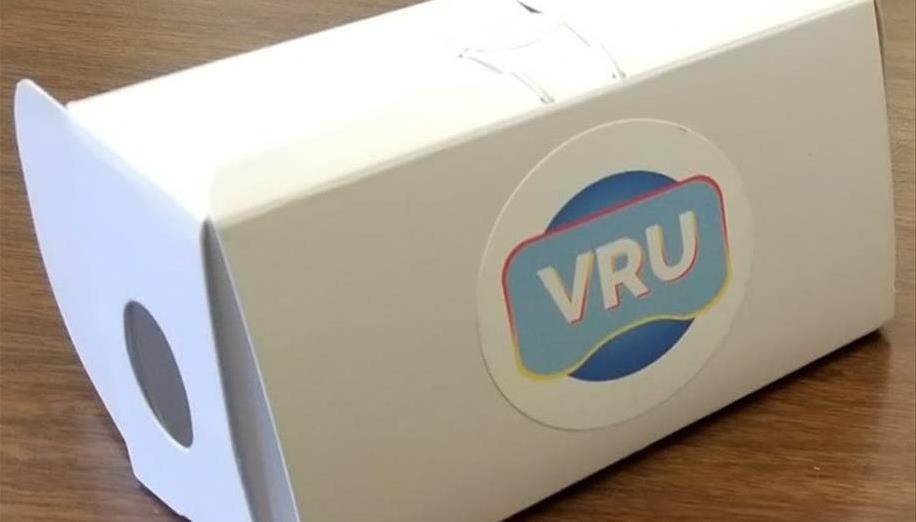
After building VRU I had to make it accessible to the class. Naively thinking the class could build the necessary cardboard headsets, I organized a headset building event before school. While there was enough participation to build the necessary headsets, many of them were falling apart and caused nausea when used. Luckily, after emailing manufacturers, I was able to get a deal from the cardboard headset company Unofficial Cardboard to get a class set of headsets for a cheap price. An experienced app developer I had worked with that summer walked me through the steps to publish my app on the iOS app store as well as the Android app store to make it available for students to download and use in class.
My app has been used several times in AP Art History to review for tests. Currently it has five AP Art History units with 8 works each and roughly 24 panoramas per unit. I was now engaged and actively working on creating educational content for VR. I wanted to see if I could take my app further to new subjects and classes and started to think about eventually offering it as a product. I decided it would be best to prove that my VR app can I prove educational outcomes to generate excitement for VR curriculum in more classes.
As part of a research methods class I took senior year, I connected with a University of Arizona professor of human computer interaction who supplied me with the research literature and information necessary to conduct my own test. I created a science VR lesson using simplified design techniques to detail the creation of photochemical smog with molecular animations as this was content recently covered by the AP Environmental Science class at my school. I conducted a test and allowed half of the 70 student participants to take part in the simulation and the other half to read a textbook article with the same information as was in the simulation. Both groups took a quiz and those who participated in the simulation scored approximately 7.7% better on average. I am now participating in an afterschool youth entrepreneurship program to figure out how to expand my app to more classes and eventually form my own company around interactive virtual reality-based experiential education.
Info zum Team
Hello! I am Cole Sohn - a high school senior at University High School in Tucson, Arizona excited to attend Stanford University this fall. My interest in using computers for digital art spans back to when I was a 2nd grader making abstract paintings in Microsoft Paint. I programming simple games using the visual scripting -based software Multimedia Fusion in middle school. This spurred my interest in computer science and 3D art. I took programming classes at University High School and participated in an afterschool program for 3D modelling and animation. I took intro college-level programming and entrepreneurship courses at the Stanford Summer College the summer before my junior year. This past summer, I took an internship and part-time job at Galatea Studio, a local 3D modelling and app-design company, where I learned to collaborate and work in a team. My current project, Virtual Reality University, has taught me more about combining the experience I have in digital art and programming.
Technologien, die wir in unseren Projekten verwenden möchten
Team has no tags setSoziale Medien
