
ÆRobotics
PUBLIC
United States, Arizona State University
Team Gallery
No gallery images have been uploaded.
Project Overview
We are ÆRobotics (http://www.ae-robots.com/) - a team of Ph.D. students from Arizona State University. In our project, we set out to solve one of the major challenges faced by the manufacturing industry today. The last few years has witnessed unprecedented investment in automating the workshop floor, with an exponential number of robots being deployed every year to work alongside humans. However, the state-of-the-art in human-robot interaction techniques does not allow for such large-scale joint operations, as a result of which the capability of the robots, and subsequently the promise of human-robot collaboration, remains quite limited. At the heart of this issue is a robot's inability to communicate effectively with the humans in the loop. We, at ÆRobotics, aim to resolve this impedance mismatch between humans and artificial agents that has so far limited effective collaboration on the factory floor. To this end, we propose to build the next generation safety helmet which combines EEG feedback and Augmented Reality to enable smooth and safe human-robot interactions in a shared workspace. Our technology consists of two key components - (1) the Consciousness Cloud which provides the robots real-time shared access to the mental state of all the humans in the workspace; and (2) the Augmented Workspace which allows the robots to communicate effectively with their human co-workers in the virtual space using a shared vocabulary of holograms. Together these two components will usher in the next generation of manufacturing workspaces by improving safety and collaboration among humans and automated components.
About Team
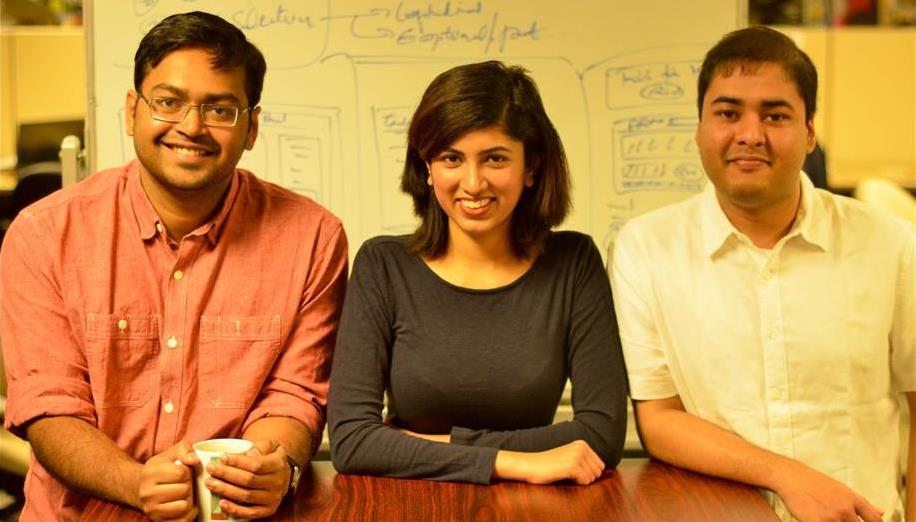
We are a team of Ph.D. students from Arizona State University.
Tathagata Chakraborti (team lead) is a fourth year Ph.D. student at Arizona State University. His research interests include planning with humans-in-the-loop, with applications in task planning for human-robot teaming and cohabitation, and proactive decision support. His research has featured in premier research conferences and workshops in the field of artificial intelligence and robotics worldwide, including AAAI, AAMAS, ICAPS, IROS, ICRA, etc. He has also received the IBM Ph.D. Fellowship and multiple University Graduate Fellowship Awards in recognition of his work.
Sarath Sreedharan is a first year Ph.D. student at Arizona State University. His research interests lie in the intersection of automated planning and Human-aware AI. While not working on the Imagine Cup project, he is usually busy teaching robots to better explain their decisions. His research has been featured in various premier research conferences, including AAMAS, ICAPS, ICRA, etc and journals like AIJ. Before starting his graduate studies, he worked as a senior software engineer at Zynga, where he helped scale up social games to support millions of players.
Anagha Kulkarni is a second year Ph.D. student majoring in Computer Science at Arizona State University. Her research interests lie in the field of Automated Planning in AI, specifically in addressing the challenges inherent in planning for human-robot team settings. She is interested in making robots behave in comprehensible fashion such that it fosters human-robot teaming. Her research work has been featured in premier robotics conferences like ICRA and RSS. Before joining ASU in 2015, she received her Master's degree in Computer Science from the University of Southern California.
Subbarao Kambhampati (team Mentor) is a professor of Computer Science & Engineering at Arizona State University, where he directs the Yochan research group. He is the Ph.D. advisor of all three members of the team. His research interests are primarily in Artificial Intelligence, and include planning and decision making, human-robot teaming and human-aware AI. He has published extensively - Google Scholar counts over 7600 citations to his work, and gives an h-index of 45. He is currently the President of the Association for the Advancement of Artificial Intelligence (AAAI), as well as an elected fellow of AAAI. He is acknowledged as an authority on automated planning and several of his contributions have found their way into popular AI textbooks. He has received multiple awards for his teaching, including best teacher awards at college and department level, and a last lecture selection at the university level.